Baby Sunscreen (2026): Under 6 Months vs Over, per FDA and AAP
What the FDA and AAP say about sunscreen before and after 6 months, then seven mineral baby sunscreens by their zinc oxide, three sun hats and a rash guard.
Independently chosen. As an Amazon Associate I earn from qualifying purchases: if you buy through our links, we may earn a commission at no cost to you. How we research
Quick answer
Under 6 months, the FDA says sunscreen is not usually recommended: keep babies in shade, lightweight long sleeves and a hat with a brim that shades the neck. From 6 months, the AAP says to use a broad-spectrum SPF 15 or higher, with zinc oxide or titanium dioxide on sensitive areas. Blue Lizard Baby and Aveeno Baby are mineral picks.
In this guide
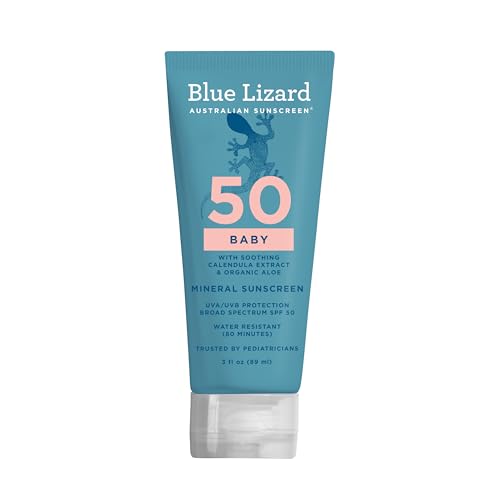
- Both mineral actives, from 6 monthsBlue Lizard Baby Mineral Sunscreen SPF 50+, 3 ozFrom the listing · not tested
- Faces and ears, in the diaper bagBlue Lizard Baby Mineral Sunscreen Stick SPF 50+From the listing · not tested


Sun protection for a baby or toddler splits at 6 months. What to use before and after that age comes first, then seven mineral sunscreens compared by the active ingredient on their drug labels, three sun hats and a rash guard.
The guidance is quoted from the FDA's consumer update Should You Put Sunscreen on Infants? Not Usually, the FDA's page Sunscreen: How to Help Protect Your Skin from the Sun, and the AAP's Sun Safety: Information for Parents About Sunburn & Sunscreen (last updated August 2024).
What the FDA and AAP say, by age
| Under 6 months | 6 months and older | |
|---|---|---|
| Shade | The AAP: "Keep babies younger than 6 months out of direct sunlight." | Still the first line; the AAP says to limit sun "between 10:00 a.m. and 4:00 p.m." |
| Sunscreen | The FDA: "Sunscreen is not recommended for infants under six months old." The AAP allows it "on small areas of the body, such as the face, if protective clothing and shade are not available." | The AAP: "a broad-spectrum sunscreen with a sun protection factor (SPF) of at least 15 (up to SPF 50)." |
| Clothing | The FDA: "lightweight clothing, such as long pants and long-sleeve shirts" | The AAP: "clothes made with a tight weave" |
| Hat | The FDA: "a hat with a brim that shades the neck" | The AAP: "a hat with an all-around 3-inch brim" |
| Sunburn | The AAP: if a baby "is younger than 1 year old and gets sunburn," call the doctor right away | Same rule up to age 1 |
The FDA explains why young babies are different: "infants are at greater risk than adults of sunscreen side effects, such as a rash," and "younger babies don't sweat like adults do," so "they can become easily overheated." It says to "check with your pediatrician before applying sunscreen to children younger than 6 months."
Every sunscreen label here carries the same line, as FDA rules require: "children under 6 months of age: Ask a doctor."
The seven sunscreens and their active ingredients
| Sunscreen | Amazon price | Active ingredient (FDA label) | Water resistance (label or listing) | Seller |
|---|---|---|---|---|
| Neutrogena Pure & Free Baby Stick | $8.97 (Amazon, as of Nov 12, 2026, 11:02 PM UTC)Check price | Zinc oxide (percentage not on the listing) | 80 minutes | Amazon.com |
| Blue Lizard Baby Stick | $8.74 (Amazon, as of Nov 12, 2026, 11:02 PM UTC)Check price | Zinc oxide 20% | 80 minutes | Amazon.com |
| Blue Lizard Baby Lotion, 3 oz | $10.78 (Amazon, as of Nov 12, 2026, 11:02 PM UTC)Check price | Titanium dioxide 8%, zinc oxide 10% | 80 minutes | Amazon.com |
| Aveeno Baby Continuous Protection, 3 oz | $13.18 (Amazon, as of Nov 12, 2026, 11:01 PM UTC)Check price | Zinc oxide 21.6% | 80 minutes | Amazon.com |
| Thinkbaby SPF 50+, 3 oz | $13.49 (Amazon, as of Nov 12, 2026, 11:01 PM UTC)Check price | Zinc oxide (20% or 23.4%, depending on label version) | 80 minutes | Thinkbaby store |
| Baby Bum Mineral SPF 50, 3 oz | $12.99 (Amazon, as of Nov 12, 2026, 11:01 PM UTC)Check price | Zinc oxide 20% | 80 minutes | Amazon.com |
| Babo Botanicals Sensitive Baby SPF 50 | $19.00 (Amazon, as of Nov 12, 2026, 11:02 PM UTC)Check price | Zinc oxide 20.0% | 80 minutes | Amazon.com |
Prices are Amazon's, as of the time shown, and subject to change. Details
How we chose: active ingredients come from each product's drug label on the National Library of Medicine's DailyMed database (it lists two Thinkbaby label versions, at 20% and a newer 23.4% zinc oxide), and every pick is sold by Amazon.com or the brand's store. We have not tested these sunscreens.

Under 6 months: shade, clothing and a hat
The AAP says: "Find shade under a tree, an umbrella, or the stroller canopy." The FDA says "the best sun protection for these infants is to stay in the shade."
Clothing does the job sunscreen will do later. The FDA recommends long pants and long-sleeve shirts, says "tight weaves are better than loose ones," and adds: "Babies should wear a hat with a brim that shades the neck."
- i play. Baby Flap Sun Protection Swim Hat, 0–6 months: a flap hat that covers the neck, with a chin tie. The listing gives no UPF number.
- Gerber UPF 50+ Long Sleeve Rash Guard: sleeves to the wrists, sized from 0–3 months.
Heat matters as much as sunburn at this age. The FDA says to "Give your child formula or breast milk if you're out in the sun for more than a few minutes." A stroller canopy is shade; a blanket draped over the whole stroller is not a canopy, and our stroller accessories guide explains why we left blackout stroller covers out.
If there's no shade at all and your pediatrician agrees, a mineral stick such as the Blue Lizard Baby Stick lets you cover just the face, the small area the AAP describes.
From 6 months: a mineral sunscreen
The AAP's rule is "a broad-spectrum sunscreen with a sun protection factor (SPF) of at least 15 (up to SPF 50)." For "sensitive areas of the body, such as the nose, cheeks, tops of the ears and shoulders," it says to "choose a sunscreen with zinc oxide or titanium dioxide." Those are the two mineral active ingredients, and every sunscreen here uses one or both.
- Blue Lizard Baby Lotion: the only lotion here with both titanium dioxide and zinc oxide.
- Aveeno Baby Continuous Protection: 21.6% zinc oxide and the National Eczema Association Seal, per its listing. It contains oat.
- Thinkbaby: zinc oxide alone, sold by the brand's own store.
- Baby Bum: a 3 oz travel tube, with coconut oil and cocoa butter.
- Babo Botanicals Sensitive Baby: fragrance-free, 20% zinc oxide.
- Blue Lizard Baby Stick and Neutrogena Pure & Free Baby Stick: for faces and ears.
What we'd buy: one lotion for arms and legs and one stick for the face.
Applying and reapplying
The AAP says to "Put sunscreen on 15 to 30 minutes before going outdoors," to "Use enough sunscreen to cover all exposed areas," and to "Reapply sunscreen every 2 hours and after swimming, sweating or drying off with a towel."
"Water resistant" is a regulated label. The FDA says these products must "state on their labels whether the sunscreen remains effective for 40 minutes or 80 minutes when swimming or sweating." Every sunscreen here lists 80 minutes. The FDA also says: "There's no such thing as 'waterproof' sunscreen," and "All sunscreens eventually wash off."
Key point: 80 minutes is the longest claim the FDA allows. After a swim or a towel-off, reapply whatever the clock says.

Hats, a rash guard and sunglasses
A hat and clothing protect without reapplying. The AAP suggests "a hat with an all-around 3-inch brim to shield the face, ears, and back of the neck."
- i play. Baby Brim Hat, 9–18 months: UPF 50+, a wide brim and an adjustable toggle.
- JAN & JUL Grow-with-Me Wide Brim UPF Hat, 6–24 months: UPF 50+ with a full neck flap, a drawstring to size up, and a chin strap with a breakaway clip.
- Gerber UPF 50+ Rash Guard: covers arms, shoulders and back at the pool.
The AAP also recommends sunglasses "with at least 99% UV protection" for children, and says to "Limit your sun exposure between 10:00 a.m. and 4:00 p.m." The FDA's page on infants uses a narrower window, 10 a.m. to 2 p.m.
If your baby gets sunburned
If your baby "is younger than 1 year old and gets sunburn," the AAP says to call their doctor right away. For older children, it says: "call your child's doctor if there is blistering, pain or fever."
Pack a thermometer with the sunscreen; see our baby thermometer guide. Our babyproofing checklist by age covers the rest of summer safety at home.
The products in this guide
In the order this guide discusses them, from listings and published standards. Where a price appears it is Amazon's, with the time it was read.
Both mineral actives, from 6 months
Blue Lizard Baby Mineral Sunscreen SPF 50+, 3 oz
From the listing · not testedBuy it from 6 months for titanium dioxide and zinc oxide in one lotion.
Pros
- + Titanium dioxide 8% and zinc oxide 10%, per its FDA label
- + 80 minutes of water resistance, per the listing
- + Fragrance-free and vegan, per the listing
Cons
- - The label says to ask a doctor before using it on babies under 6 months, like every sunscreen here
Faces and ears, in the diaper bag
Blue Lizard Baby Mineral Sunscreen Stick SPF 50+
From the listing · not testedBuy it for faces and ears; the stick fits in the diaper bag.
Pros
- + Zinc oxide 20%, per its FDA label
- + A stick for faces, ears and noses; 80 minutes of water resistance on the label
- + Fragrance-free
Cons
- - Only 0.5 oz, so it is for spots, not whole-body coverage
Zinc oxide as the only active
Thinkbaby Baby Sunscreen SPF 50+, 3 oz
From the listing · not testedBuy it if you want zinc oxide as the only active ingredient.
Pros
- + Zinc oxide is the only active ingredient, per its FDA label
- + 80 minutes of water resistance, per the listing
- + No oxybenzone or avobenzone, per the listing
Cons
- - Sold by the Thinkbaby brand store rather than Amazon.com

Sensitive or eczema-prone skin
Aveeno Baby Continuous Protection Zinc Oxide SPF 50, 3 oz
From the listing · not testedBuy it for sensitive or eczema-prone skin; it carries the eczema association's seal.
Pros
- + Zinc oxide 21.6%, per its FDA label
- + Reapply after 80 minutes of swimming or sweating, per the listing
- + Carries the National Eczema Association Seal of Acceptance, per the listing
Cons
- - Contains oat, which is worth knowing for a child with an oat allergy

A second face stick
Neutrogena Pure & Free Baby Mineral Sunscreen Stick SPF 50
From the listing · not testedBuy it as a second face stick; check the pack size at checkout.
Pros
- + Zinc oxide is the active ingredient, per the listing
- + Water resistant for up to 80 minutes, per the listing
- + National Eczema Association Seal of Acceptance, per the listing
Cons
- - The listing title says 2-pack but its description says one stick; check the pack size at checkout

Fragrance-free zinc lotion
Babo Botanicals Sensitive Baby Mineral Sunscreen SPF 50
From the listing · not testedBuy it for very sensitive skin: fragrance-free, with 20% zinc oxide.
Pros
- + Zinc oxide 20.0%, per its FDA label
- + 80 minutes of water and sweat resistance, per the listing
- + Fragrance-free
Cons
- - The label says to ask a doctor before using it on babies under 6 months, like every sunscreen here

Beach trips and carry-ons
Baby Bum Mineral SPF 50 Sunscreen Lotion, 3 oz
From the listing · not testedBuy it for beach trips; the 3 oz tube fits a carry-on.
Amazon listed this as shipping later, not in stock now, as of Nov 12, 2026, 11:01 PM UTC.
Pros
- + Zinc oxide 20%, per its FDA label
- + Reapply after 80 minutes of swimming, per the listing
- + Travel size fits a carry-on
Cons
- - Contains coconut oil and cocoa butter, which some families avoid

Shade under 6 months
i play. Baby Flap Sun Protection Swim Hat, 0–6 Months
From the listing · not testedBuy it for a baby under 6 months; the flap shades the neck.
Pros
- + A full-coverage flap that shades the neck, the fit the FDA describes for infants
- + Elastic back and a chin tie for fit
- + Machine washable
Cons
- - The listing does not give a UPF number

Wide brim, 9 to 18 months
i play. Baby Brim Hat, UPF 50+, 9–18 Months
From the listing · not testedBuy it for an older baby: UPF 50+ and a wide brim.
Pros
- + UPF 50+, per the listing
- + Wide brim for head, neck and eyes
- + Adjustable toggle and a wicking liner
Cons
- - Sized by age, so a baby may need a new one each season

A hat that sizes up
JAN & JUL Grow-with-Me Wide Brim UPF Hat, 6–24 Months
From the listing · not testedBuy it for a toddler: the chin strap keeps it on, the drawstring sizes up.
Pros
- + UPF 50+ fabric and a full neck flap, per the listing
- + Adjustable head drawstring to size up across seasons
- + Chin strap with a breakaway safety clip
Cons
- - Sold by the JAN & JUL brand store rather than Amazon.com

Less skin to sunscreen
Gerber Baby Toddler UPF 50+ Long Sleeve Rash Guard
From the listing · not testedCovers the arms and back so there is less skin to sunscreen.
Pros
- + UPF 50+, per the listing
- + Sleeves to the wrists and a longer body
- + Sizes from 0–3 months to 5T
Cons
- - A top only; pair it with a swim diaper or bottoms
Frequently Asked Questions
Is SPF 50+ better than SPF 30 for a baby?
Not proven. The AAP's sun safety page says "An SPF of 15 or 30 should be fine for most people," and that more research is needed to test whether anything above SPF 50 adds protection.
Should I avoid oxybenzone?
If you can. The AAP says to avoid it "because of concerns about mild hormonal properties," but adds that "using any sunscreen is better than not using sunscreen at all."
Does my baby need sunscreen on a cloudy day?
Yes, from 6 months. The AAP says you can burn on cloudy days "because up to 80% of the sun's UV rays can get through the clouds," and that UV bounces back from water, sand, snow and concrete.
What if my baby rubs sunscreen into their eyes?
Wipe their eyes and hands clean with a damp cloth, the AAP says. If a sunscreen irritates the skin, try a different one with zinc oxide or titanium dioxide, and talk to the doctor about any rash.
This guide is for general information and is not medical advice. Ask your pediatrician before using sunscreen on a baby under 6 months, and call right away if a baby under 1 gets sunburned.
Proof
Sources
Everything this guide relies on, as linked in the text. Last checked September 28, 2026.
- U.S. Food and Drug Administration: Should You Put Sunscreen on Infants? Not Usually
- U.S. Food and Drug Administration: Sunscreen: How to Help Protect Your Skin from the Sun
- American Academy of Pediatrics: Sun Safety: Information for Parents About Sunburn & Sunscreen
- National Institutes of Health: DailyMed
Amazon prices and availability change often; cards with a live Amazon price show when it was last checked. As an Amazon Associate I earn from qualifying purchases.


