Bottle Sterilizers and Drying Racks (2026): CDC Rules
Steam sterilizers, microwave bags and drying racks set against the CDC's advice on when to sanitize and how to dry bottles, and when a clean towel is enough.
Independently chosen. As an Amazon Associate I earn from qualifying purchases: if you buy through our links, we may earn a commission at no cost to you. How we research
Quick answer
The CDC says to sanitize feeding items daily when your baby is under 2 months, premature or has a weakened immune system; older healthy babies may not need it daily. A dishwasher with a heated drying cycle counts, and boiling for 5 minutes costs nothing. If you want steam, Medela Quick Clean microwave bags are the simplest start.
In this guide
- Daily sanitizing with drying built inDr. Brown's All-in-One Sterilizer and DryerFrom the listing · not tested
- Pumping parents and many bottlesBaby Brezza Bottle Sterilizer and Dryer AdvancedFrom the listing · not tested


Before buying a sterilizer, a steam bag or a drying rack, check what the CDC's cleaning guide asks for. It comes first below, then six sterilizers and steam bags and three racks compared against it.
How we chose: nine products sold by Amazon.com, described from their listings and makers' claims and not tested by us, measured against the CDC's How to Clean, Sanitize, and Store Infant Feeding Items.
We found no CPSC recalls of sterilizers or drying racks from these brands. Boon's June 2026 recall covers its NURSH 8 oz bottles, a different product from the Lawn rack here (CPSC notice).
The nine side by side
| Product | Type | Capacity (per brand) | Dries? | Sold by | Amazon price |
|---|---|---|---|---|---|
| Baby Brezza Sterilizer Dryer Advanced | Electric steam + dryer | 8 bottles + 2 pump sets | Yes (HEPA) | Amazon.com | $102.99 (Amazon, as of Nov 12, 2026, 11:02 PM UTC)Check price |
| Dr. Brown's All-in-One | Electric steam + dryer | 6 bottles + parts | Yes | Amazon.com | $59.99 (Amazon, as of Nov 12, 2026, 11:02 PM UTC)Check price |
| Dr. Brown's Deluxe | Electric steam | 6 bottles + parts | No | Amazon.com | $50.99 (Amazon, as of Nov 12, 2026, 11:01 PM UTC)Check price |
| Chicco 3-in-1 | Electric or microwave steam | 6 bottles | No | Amazon.com | $49.99 (Amazon, as of Nov 12, 2026, 11:02 PM UTC)Check price |
| Dr. Brown's Silicone Bag | Microwave steam bag | 2 bottles + parts | No | Amazon.com | $16.99 (Amazon, as of Nov 12, 2026, 11:02 PM UTC)Check price |
| Medela Quick Clean Bags | Microwave steam bags (12) | Pump parts + bottles | No | Amazon.com | $12.89 (Amazon, as of Nov 12, 2026, 11:02 PM UTC)Check price |
| Boon Lawn | Drying rack | Countertop tray | Air | Amazon.com | $21.99 (Amazon, as of Nov 12, 2026, 11:01 PM UTC)Check price |
| OXO Tot Drain Board Rack | Drying rack | Up to 8 bottles | Air | Amazon.com | $22.98 (Amazon, as of Nov 12, 2026, 11:01 PM UTC)Check price |
| Munchkin High Capacity | Drying rack | Up to 16 bottles | Air | Amazon.com | $13.79 (Amazon, as of Nov 12, 2026, 11:01 PM UTC)Check price |
Prices are Amazon's, as of the time shown, and subject to change. Details
When the CDC says to sanitize
The CDC separates cleaning (washing off milk and formula) from sanitizing (an extra step to kill remaining germs). On sanitizing, it says:
- "For extra germ removal, sanitize feeding items at least once daily. Sanitizing is particularly important when your baby is younger than 2 months, was born prematurely, or has a weakened immune system."
- "Daily sanitizing of feeding items may not be necessary for older, healthy babies, if those items are cleaned carefully after each use."
- "If you use a dishwasher with hot water and a heated drying cycle (or sanitizing setting) to clean infant feeding items, a separate sanitizing step is not necessary."
Sanitizing only works on items that are already clean. The CDC says to clean feeding items, bottle brushes and wash basins first, then sanitize everything, "even the bottle brush and wash basin."
The CDC's three ways to sanitize
The CDC lists three and says to check with the item's manufacturer about which to use:
- Boil. Put disassembled items in a pot, cover with water, bring to a boil and "Boil for 5 minutes." Remove with clean tongs.
- Steam. "Place disassembled items in microwave or plug-in steam system and follow the manufacturer's instructions for sanitizing, cooling, and drying the items." Every sterilizer and bag here works this way, and the CDC adds that if you steam an item, "be sure the entire item fits in the steamer."
- Bleach, if you can't boil, steam or use a dishwasher. Mix "2 teaspoons of unscented bleach per gallon (16 cups) of water," submerge everything with no air bubbles, soak for at least 2 minutes, and don't rinse. The CDC says any remaining bleach "will break down quickly as it dries and will not hurt your baby."

Electric sterilizers
If you sanitize daily and want drying built in: the Dr. Brown's All-in-One steams and dries six bottles. The Baby Brezza Advanced holds eight bottles and two full pump part sets and dries with HEPA-filtered air, per the brand. Baby Brezza says contents stay sterile for 48 hours inside, and Dr. Brown's says up to 24 hours with the lid shut; those are the makers' claims.
If you will air-dry anyway: the Dr. Brown's Deluxe and Chicco 3-in-1 steam without a dryer, and the Chicco also works in the microwave, per the listing.
Steam sterilizers leave mineral scale on the heating plate; Baby Brezza tells owners to descale regularly, so check your model's manual for the method.
Microwave steam bags
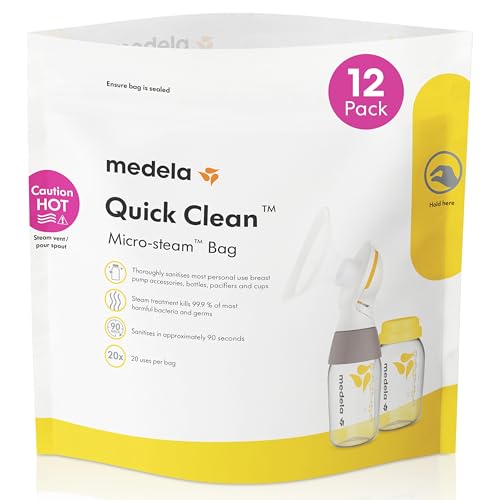
The Medela Quick Clean bags (12 per box) and the reusable Dr. Brown's silicone bag use your microwave to make steam. Medela says each bag can be reused up to 20 times and cleans pump parts in 3 minutes.
Dr. Brown's says to add 2 oz of water, microwave for 3 minutes in a 700 to 1250 watt microwave, and let the bag sit 10 minutes before handling. Follow the maker's steps exactly, since the CDC's steam method depends on them.
Bags suit pumping at work, travel, and the occasional sanitize once your baby is older and healthy.
Drying: a clean towel may beat a rack
The CDC says to "Allow to air dry thoroughly," on "a clean, unused dish towel or paper towel in an area protected from dirt and dust," and warns: "Do not use a dish towel to rub or pat items dry because doing so may transfer germs to the items."
On racks it says: "Air-drying infant feeding items on a clean dish towel or paper towel is probably more hygienic than using a drying rack. Drying racks may trap moisture, allow mold and germs to grow, and be difficult to clean."
If you use a rack, the CDC says to keep it for your baby's feeding items only and, every few days (or at least daily if your baby is under 2 months, premature or has a weakened immune system), "wash it, sanitize it, and allow it to dry thoroughly."

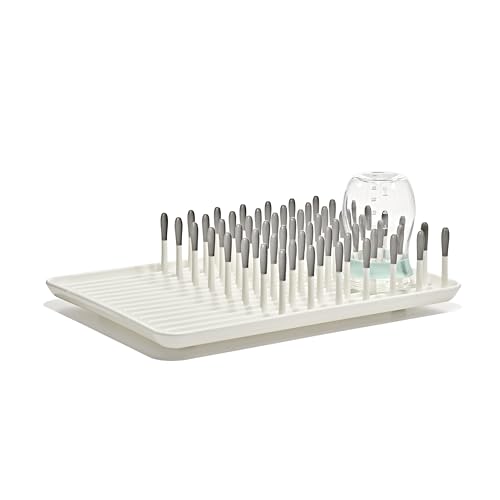
Fewer parts means less to scrub. The Boon Lawn splits into two pieces with a removable tray that Boon says is antimicrobial. The OXO Tot holds eight bottles over a drain board. The Munchkin holds the most, 16 bottles, but has the most pegs to wash.
Pro tip: with a sanitizing dishwasher, a rack or clean towels is all you need. For a newborn, a preemie or a pumping parent, a sterilizer dryer saves boiling every day.
Storing clean bottles
Once everything is completely dry, the CDC says to wash your hands, reassemble the parts and store them "in a clean, protected area such as inside a closed kitchen cabinet that is used only to store clean dishes." Items stored damp can grow mold.
Related: bottles for breastfed babies, our formula prep guide with the CDC's extra step for newborns, and our breast pump guide for the parts you will be cleaning.
The products in this guide
In the order this guide discusses them, from listings and published standards. Where a price appears it is Amazon's, with the time it was read.
Daily sanitizing with drying built in
Dr. Brown's All-in-One Sterilizer and Dryer
From the listing · not testedBuy it if you sanitize daily and want steaming and drying in one unit.
Pros
- + Steam-sterilizes up to six Narrow or Wide-Neck bottles plus parts, per Dr. Brown's
- + Sterilize only, dry only, both, or storage modes; auto shut-off
- + Dr. Brown's says contents stay sterile up to 24 hours if the lid stays shut
Cons
- - Only needed if you lack a dishwasher sanitize cycle or prefer not to boil
Pumping parents and many bottles
Baby Brezza Bottle Sterilizer and Dryer Advanced
From the listing · not testedBuy it for the most capacity here: 8 bottles and 2 pump part sets.
Pros
- + Holds 8 bottles and 2 full breast pump part sets, per Baby Brezza
- + Steam cycle of about 10 minutes, then HEPA-filtered drying at 30, 45 or 60 minutes
- + Four modes including storage; Baby Brezza says contents stay sterile 48 hours
Cons
- - Needs regular descaling, per the brand
Air-drying on a towel anyway
Dr. Brown's Deluxe Electric Sterilizer
From the listing · not testedBuy it if you will air-dry on a towel and only need the steam.
Pros
- + Steam-sterilizes up to six bottles plus parts and pacifiers, per Dr. Brown's
- + Cycle indicators for heat, cool-down and ready; auto shut-off
- + Includes measuring cup and tongs
Cons
- - Sterilizes only; no drying function listed

Plug-in at home, microwave away
Chicco 3-in-1 Electric Steam Sterilizer
From the listing · not testedBuy it for plug-in steam at home with a microwave mode for travel.
Pros
- + Full-size (up to 6 bottles), compact Eco or microwave mode, per Chicco
- + Microwave mode sanitizes in as little as 2 minutes at 1200 watts, per the listing
- + Chicco says contents stay sterile up to 24 hours unopened
Cons
- - No drying function listed

Small loads and travel
Dr. Brown's Microwave Steam Silicone Sterilizer Bag
From the listing · not testedBuy it for small loads or travel; one bag is reusable.
Pros
- + Holds two Dr. Brown's bottles plus parts; add 2 oz of water and microwave 3 minutes, per Dr. Brown's
- + Reusable silicone; dishwasher safe and self-standing
- + Side-grip hooks for handling
Cons
- - Dr. Brown's says to let it sit 10 minutes before handling; small capacity
Pumping at work
Medela Quick Clean Micro-Steam Bags (12 count)
From the listing · not testedBuy it for steam with no appliance, handy for pumping at work.
Pros
- + Steam-cleans pump parts and bottles in the microwave in 3 minutes, per Medela
- + Each bag reusable up to 20 times
- + Made without BPA or phthalates, per Medela
Cons
- - Disposable after 20 uses; you still wash items first

Fewest parts to wash
Boon Lawn Countertop Drying Rack
From the listing · not testedBuy it for a low-profile rack that splits in two for washing.
Pros
- + Two-piece design with a removable water tray that drains excess water, per Boon
- + Antimicrobial tray to resist mold and mildew, per the brand
- + Made without BPA or PVC
Cons
- - The CDC says any rack needs regular washing and sanitizing
Draining into the sink
OXO Tot Baby Bottle Drying Rack with Drain Board
From the listing · not testedBuy it for a drain board and room for eight bottles plus pump parts.
Pros
- + Holds up to eight bottles upright, per OXO
- + Silicone-tipped tines; channels and rounded corners for pouring out water
- + Room for pacifiers and pump parts
Cons
- - Tines and channels are extra surfaces to clean

The most bottles at once
Munchkin High Capacity Drying Rack
From the listing · not testedBuy it if you dry up to 16 bottles at once and accept more pegs to wash.
Pros
- + Holds up to 16 bottles on a two-tier, spinning design, per Munchkin
- + Pegs fold down; reversible drip tray catches water or drains to the sink
Cons
- - More pegs and parts to wash and sanitize
Frequently Asked Questions
Do bottles need washing after every feed?
Yes. The CDC's cleaning guide says "Bottles should be cleaned after every feeding," with all parts separated first: bottles, nipples, caps, rings and valves.
Can I wash bottles in the kitchen sink?
Not directly. The CDC says "Do not wash directly in the sink because it may contain germs that could contaminate these items." Use a wash basin kept for feeding items.
How often should I clean the bottle brush?
Rinse it and let it air-dry after each use, and wash it every few days, the CDC says, in a hot dishwasher with a heated drying cycle if it is dishwasher-safe, or by hand with soap and warm water. Keep it for feeding items only.
Proof
Sources
Everything this guide relies on, as linked in the text. Last checked September 28, 2026.
- Centers for Disease Control and Prevention: How to Clean, Sanitize, and Store Infant Feeding Items
- U.S. Consumer Product Safety Commission: CPSC notice
NurseryProof is a participant in the Amazon Services LLC Associates Program, an affiliate advertising program designed to provide a means for sites to earn advertising fees by advertising and linking to Amazon.com. This guide summarizes public guidance and is not medical advice; ask your pediatrician how to clean feeding items for your baby.
Amazon prices and availability change often; cards with a live Amazon price show when it was last checked. As an Amazon Associate I earn from qualifying purchases.